
If you’re navigating a child support case in Maryland, you probably already know that the state uses a specific formula—the Child Support Guidelines—to decide who pays what. But life isn’t always as simple as one income and one set of kids. Many parents in Annapolis and Prince George’s County are part of blended families, supporting children from different relationships at the same time.
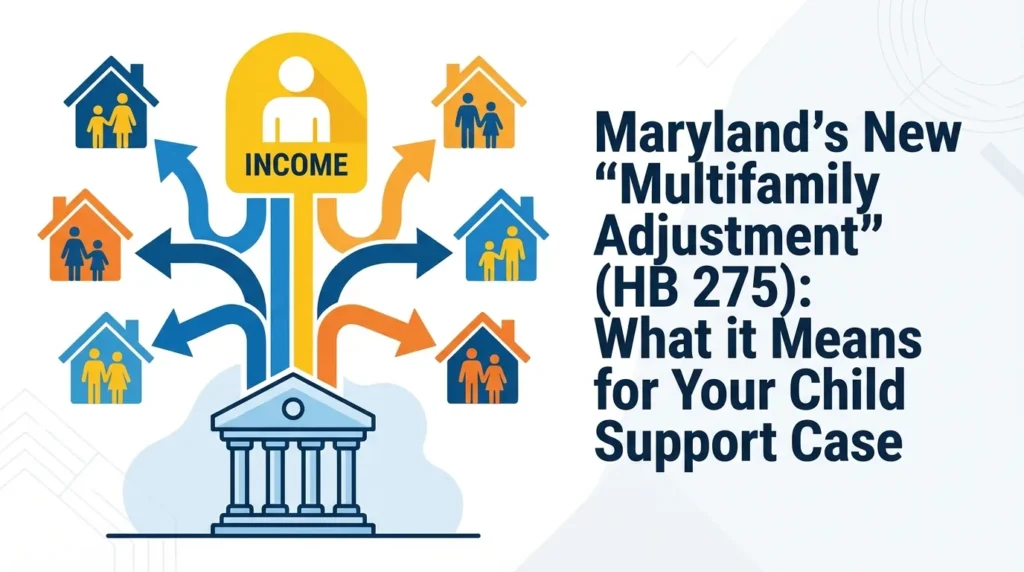
Until recently, the law didn’t always give parents a fair “credit” for the children living in their home if those children weren’t part of the specific court case at hand. That changed with House Bill 275, which introduced the multifamily adjustment.
How the formula used to work (and why it was frustrating)
Maryland’s guidelines have always looked at your “actual income.” You could deduct things like alimony you were already paying or child support for a different case that was already on the books. But if you had a child from a new marriage living with you, the court didn’t have a clear, consistent way to “discount” your income to account for the cost of raising that child. You were essentially being asked to pay support as if that second family didn’t exist.
What HB 275 changes
The new multifamily adjustment fixes this by allowing a deduction for children living in your home, provided you have a legal duty to support them.
To qualify for this adjustment, the child has to spend more than 92 overnights a year in your house. If they meet that threshold, the law allows for a deduction equal to 75% of what the basic support obligation would be for that child. This amount is taken off your “actual income” before the final support calculation is made for the case you’re currently in. It’s a way to make sure parents aren’t being stretched so thin that they can’t support the children actually living under their roof.
It isn’t automatic
One thing I always tell clients is that just because a law exists doesn’t mean the judge will apply it without question. HB 275 gives judges the power to skip the adjustment if they think it would be “unjust” or if it would hurt the child’s best interests.
The court might look at your overall financial picture—things like who is paying the mortgage, whether there are college expenses involved, or if your income is already near the federal poverty line. Because there is room for interpretation here, you can’t just assume the math will go your way. You have to ask for the adjustment and show why it’s fair.
Practical steps for parents
If you think this adjustment applies to you, start gathering your proof now. You’ll need:
- Overnight records: If you don’t have a formal schedule, start tracking nights on a calendar. 92 nights is the magic number.
- Legal documentation: Have birth certificates or adoption papers ready to prove your legal duty to the “additional” children.
- Financial context: Be ready to show your full household budget, especially if you’re arguing that the adjustment is necessary to keep your household afloat.
Bottom Line
The multifamily adjustment is a long-overdue recognition of how modern families actually look. Whether you are the parent who might see their obligation decrease, or the parent worried about a drop in support, you need to know how these numbers are going to shift.
If you’re dealing with a support modification or a new filing, it’s worth sitting down with a lawyer to run the numbers under the new HB 275 rules. Every case is different, and a small change in how your income is “adjusted” can add up to thousands of dollars over the years.
You can find the full text of the law on the Maryland General Assembly’s website. For more on the basics, check out our child support page or see Child support on Wikipedia. We also have more info on modifications and separation agreements if you’re looking to change an existing order.
This article is for general informational purposes and is not legal advice.
